


Partial vs. Total Knee Replacement: Which Is Right for You?
- Aug 12
- 5 min read
Knee pain can gradually turn everyday activities into challenges. Walking through the grocery store, climbing stairs, getting out of a chair, exercising, or simply enjoying time with family may become increasingly difficult. When medications, injections, physical therapy, and other conservative treatments no longer provide enough relief, knee replacement surgery may be considered.
But not every patient needs the entire knee joint replaced.
Depending on where arthritis or joint damage is located, some patients may be candidates for a partial knee replacement, while others may benefit more from a total knee replacement. Understanding the difference can help you have a more informed conversation with your orthopedic surgeon.
What Is a Partial Knee Replacement?
The knee is divided into three main compartments: the medial compartment on the inside of the knee, the lateral compartment on the outside, and the patellofemoral compartment where the kneecap meets the thighbone.
A partial knee replacement, also called a unicompartmental knee replacement, is generally used when arthritis is primarily limited to one compartment of the knee.
Instead of replacing the entire joint, the surgeon removes damaged bone and cartilage from the affected area and replaces only that portion with an implant. Healthy portions of the knee, along with certain ligaments and natural structures, can be preserved.
For appropriately selected patients, preserving more of the natural knee may provide excellent pain relief and function.
What Is a Total Knee Replacement?
A total knee replacement, also known as total knee arthroplasty, is typically considered when arthritis or joint damage affects multiple areas of the knee.
During the procedure, damaged surfaces at the ends of the femur and tibia are removed and replaced with carefully positioned implants. The underside of the kneecap may also be treated or resurfaced depending on the patient's anatomy and the surgeon's approach.
Despite its name, a total knee replacement does not mean the entire knee is removed. The procedure replaces the damaged joint surfaces while preserving much of the surrounding bone, muscles, tendons, and other tissues.
What Are the Main Differences?
The biggest difference between partial and total knee replacement is how much of the knee is affected by arthritis and therefore needs to be treated.
A partial knee replacement focuses on a specific damaged compartment while preserving more of the patient's natural knee. A total knee replacement treats a broader portion of the joint and is generally used when arthritis is more widespread.
Potential differences may also include the size of the surgical area, rehabilitation needs, implant design, and recovery experience. However, outcomes vary from patient to patient, and a smaller operation is not automatically the better operation.
The goal is to perform the procedure that best addresses the patient's specific joint damage.
Who May Be a Candidate for Partial Knee Replacement?
Partial knee replacement may be considered when:
Arthritis is primarily confined to one compartment of the knee
The remaining portions of the knee have relatively healthy cartilage
Certain important knee ligaments remain functional
Knee alignment and range of motion are appropriate for the procedure
Conservative treatments are no longer providing adequate relief
Pain is significantly interfering with everyday activities
Age alone does not determine whether someone qualifies for partial knee replacement. Your orthopedic surgeon will consider your anatomy, activity level, symptoms, ligament stability, overall health, and the location and severity of the arthritis.
When Is Total Knee Replacement More Appropriate?
Total knee replacement may be recommended when arthritis has progressed throughout multiple areas of the knee.
Patients may experience persistent pain, stiffness, swelling, reduced mobility, difficulty walking, trouble climbing stairs, or pain that interferes with sleep and everyday activities.
A total knee replacement may also be more appropriate when significant deformity, instability, or widespread cartilage loss is present.
The decision should be based on the condition of the entire knee rather than pain alone.

How Does Your Surgeon Determine Which Procedure You Need?
Choosing between partial and total knee replacement starts with a comprehensive orthopedic evaluation.
Your surgeon may review your medical history, examine the knee, evaluate stability and range of motion, and obtain imaging such as weight-bearing X-rays. In certain situations, additional imaging may be helpful.
The location of cartilage loss is particularly important.
For example, a patient experiencing severe pain on the inside of the knee may have arthritis isolated primarily to the medial compartment. If the remainder of the joint and important supporting structures are healthy, partial knee replacement could potentially be considered.
If imaging demonstrates significant arthritis throughout several compartments, total knee replacement may provide a more appropriate solution.
Does Partial Knee Replacement Have a Faster Recovery?
Because partial knee replacement generally involves a smaller portion of the joint, some appropriately selected patients may experience a faster early recovery compared with total knee replacement.
However, recovery is highly individual.
Your age, health, physical condition before surgery, surgical approach, rehabilitation, and the condition of the knee can all influence how quickly you recover.
The goal should not simply be choosing whichever procedure sounds easier. The goal is choosing the operation most likely to address the underlying problem and provide lasting improvement.
Can Robotic Technology Be Used?
Robotic-assisted technology may be used for certain partial and total knee replacement procedures.
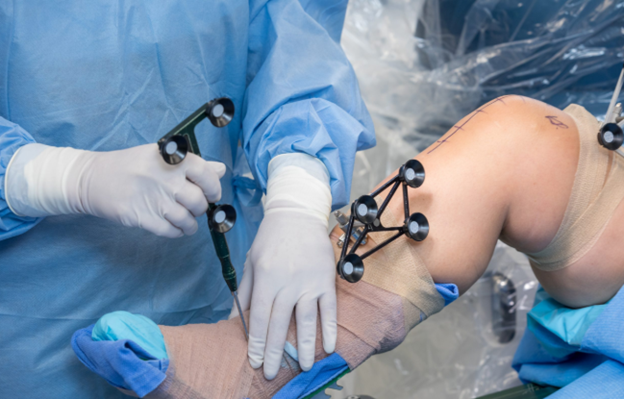
Systems such as MAKO robotic-arm assisted surgery can help surgeons develop a patient-specific surgical plan based on the patient's anatomy. During surgery, robotic technology assists the surgeon with executing that plan and positioning components within the planned parameters.
The surgeon remains in control of the procedure throughout the operation.
Robotic technology is a surgical tool. The experience of the orthopedic surgeon, appropriate patient selection, implant choice, rehabilitation, and many other factors remain important parts of successful joint replacement care.
Is Partial Knee Replacement Always Better Because It Preserves More of the Knee?
Not necessarily.
Preserving healthy bone and tissue can be advantageous when a patient is an appropriate candidate for partial knee replacement. But performing a partial replacement when arthritis is too widespread could leave untreated areas of the knee that continue to cause symptoms.
Likewise, performing a total knee replacement when only a specific portion of the knee is severely damaged may not always be necessary.
This is why proper diagnosis and patient selection are so important.
The best procedure is not automatically the smallest or largest operation. It is the procedure that appropriately treats the patient's individual condition.
What Happens If Arthritis Progresses After a Partial Knee Replacement?
Arthritis can sometimes develop or progress in other compartments of the knee after a partial knee replacement.
If symptoms eventually become severe enough, revision surgery may be considered. In some cases, a partial knee replacement can be converted to a total knee replacement.
Your surgeon can discuss this possibility as part of the long-term benefits and risks of each treatment option.
When Should You See an Orthopedic Surgeon?
Occasional knee discomfort does not necessarily mean you need surgery.
However, an orthopedic evaluation may be appropriate if knee pain has become persistent, limits your mobility, prevents you from participating in activities you enjoy, interferes with sleep, or continues despite nonsurgical treatment.
Joint replacement is generally considered after conservative options have been explored and symptoms are significantly affecting quality of life.
Partial or Total: The Right Choice Depends on Your Knee
There is no single knee replacement procedure that is right for everyone.
For patients with arthritis isolated to one portion of the knee, partial knee replacement may preserve more of the natural joint while addressing the damaged area. For patients with more extensive arthritis, total knee replacement may provide a more comprehensive solution.
The most important step is determining where the damage is located and how advanced it has become.
A consultation with an orthopedic joint replacement specialist, along with a physical examination and appropriate imaging, can help determine whether nonsurgical treatment, partial knee replacement, or total knee replacement is the best option for your individual needs.
This article is intended for general educational purposes and should not replace an evaluation or medical advice from a qualified healthcare professional.


Comments